Everyone treats a lead list like milk. It expires, so you toss it and buy a fresh one.
We built a workflow that treats it like a garden instead. It refreshes itself.
The problem: your lead list does not decay all at once
Your list gets stale one job change at a time. Someone moves to a new company, and suddenly their email dies, their title is wrong, and the account they were associated with no longer reflects reality.
Most teams catch this during a painful annual cleanup. By then, months of outreach may have gone to outdated contacts.
The real opportunity is to respond when data changes, not months later.
Two lanes, one connected workflow
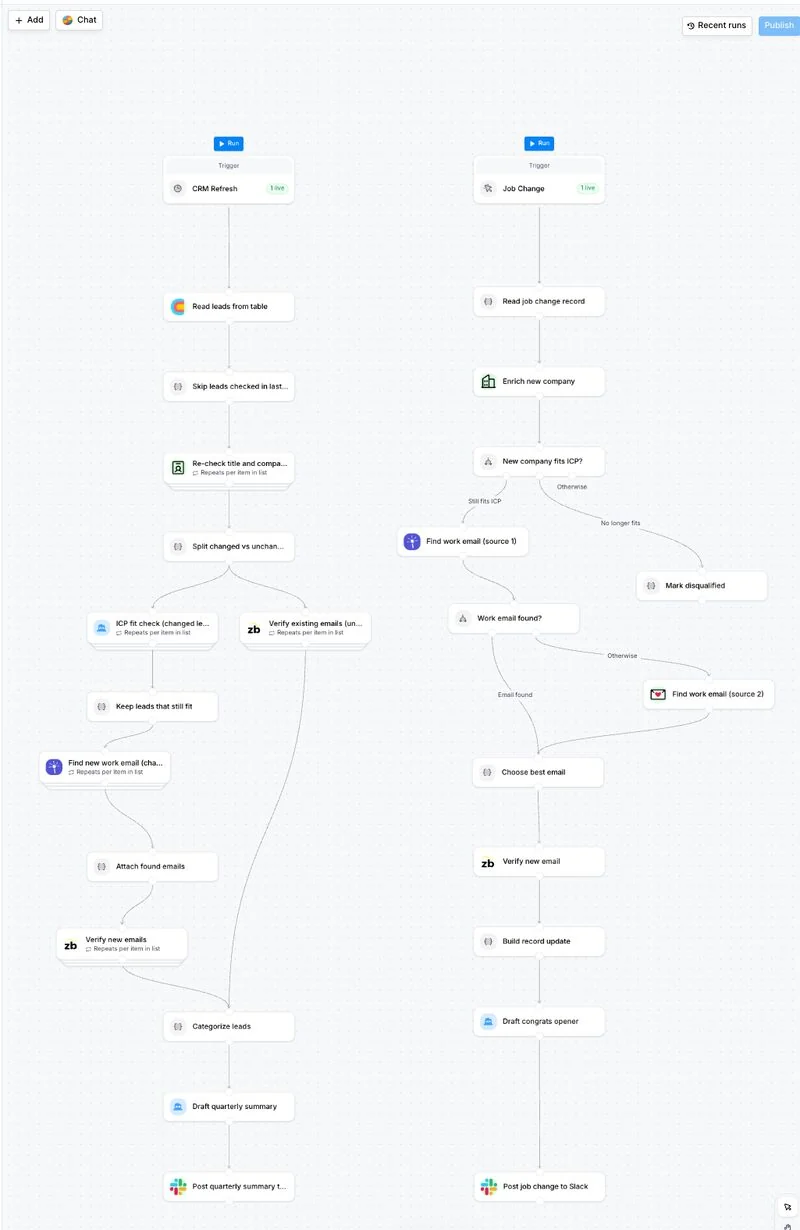
We designed two automation lanes on one canvas. One reacts to new job changes. The other handles the slower decay that happens across an existing CRM.
Lane 1: A job change becomes a warm conversation
When a job change appears, this lane reads the record, enriches the new employer, and checks whether that company still fits the ideal customer profile (ICP).
If it fits, the system looks up a new work email, falls back to another source when needed, verifies the result, and prepares the CRM record for an update. If it does not fit, the record is flagged as disqualified.
Then it drafts a congratulations-on-the-new-role note.
That last step is the key insight: a job change is not only a data hygiene event. It can be a warm opportunity. A contact who already knows your team may have moved into another relevant account.
Lane 2: The quarterly health check
Not all data decay comes with a job change. Titles drift, emails stop working, and accounts gradually move away from the original ICP.
The second lane runs a quarterly CRM sweep. It skips recently checked records, verifies account and contact fit, finds updated work emails where needed, and verifies them before categorizing the records.
Instead of creating one massive cleanup project, it prepares a focused summary for the team and sends it to Slack.
What the workflow connects
- Triggers: job-change signals and a scheduled CRM refresh.
- Qualification: new-company enrichment and ICP checks.
- Enrichment: work email discovery with a fallback source.
- Verification: re-checks before records are updated.
- Activation: a draft personal note when someone moves roles.
- Visibility: categorized updates and a quarterly Slack summary.
The bigger lesson
The old way is to buy a new lead list every few months. The new way is to keep improving the one you have while finding timely reasons to reconnect.
Maintenance and lead generation are not separate jobs. Done thoughtfully, the same system can support both.
This is a breakdown of a workflow design and its intended operations, not a claim of measured campaign performance.
Want to build a similar system around your CRM and outbound stack? Let's talk about your existing tools and the signals that matter to your market.